
Just a few years ago, AI marketing tools were largely associated with content generation. Businesses experimented with AI writers, image generators, and chatbot assistants to improve productivity and reduce manual work.
In 2026, the conversation changed entirely.
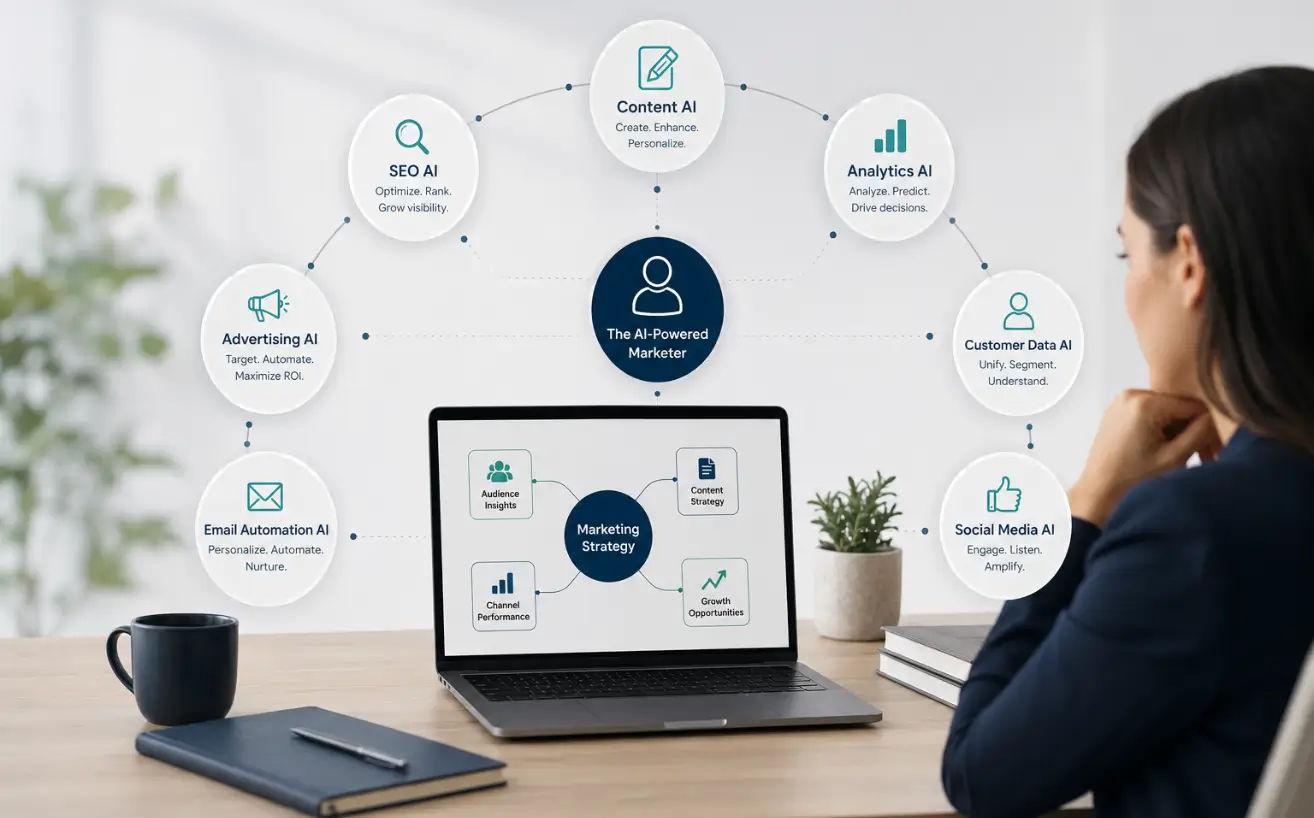
Artificial intelligence is no longer a standalone productivity tool. It has become part of the marketing infrastructure itself. Organizations now use AI to plan campaigns, identify audience opportunities, optimize content for search visibility, predict customer behavior, automate workflows, and generate actionable insights from vast amounts of data.
At the same time, the market has become increasingly crowded. Hundreds of platforms claim to offer AI capabilities, making it difficult for businesses to determine which solutions deliver genuine value and which are simply adding another layer of complexity.
Understanding the AI marketing tool landscape in 2026 is not about finding the latest software. It is about understanding where the industry is heading and how marketers can build technology stacks that support sustainable growth.
What the AI Marketing Tool Landscape Looks Like in 2026
One of the biggest changes in recent years is the shift away from isolated AI tools toward integrated marketing ecosystems.
During the early wave of AI adoption, companies often purchased separate tools for writing content, creating visuals, conducting keyword research, scheduling social media posts, and generating reports. While these solutions improved efficiency in specific areas, they also created fragmented workflows and disconnected data.
Today, businesses are prioritizing platforms that combine multiple capabilities within a single environment.
Instead of maintaining a collection of unrelated applications, marketing teams increasingly prefer solutions that connect content creation, analytics, automation, customer data, and campaign management.
This shift is being driven by three factors:
1. Data Fragmentation
When information is spread across multiple platforms, it becomes difficult to gain a complete view of customer behavior and marketing performance.
2. Rising Software Costs
Many organizations are reducing software expenses by consolidating overlapping tools into fewer platforms with broader capabilities.
3. Demand for Faster Execution
Marketing teams are expected to produce more content, manage more channels, and respond more quickly to changing market conditions. Integrated AI platforms help streamline execution without increasing headcounts.
As a result, the AI marketing landscape in 2026 is less about individual tools and more about connected systems that support the entire marketing lifecycle.
The Five AI Marketing Categories Receiving the Most Investment
While new AI solutions continue to emerge, several categories are attracting the majority of business investment.
1. AI Content and Creative Platforms
Content remains the foundation of digital marketing, but expectations around quality and volume continue to rise.
Modern AI content platforms help teams accelerate the production of:
- Blog content
- Landing pages
- Email campaigns
- Product descriptions
- Social media posts
- Ad copy
- Video scripts
However, successful organizations have moved beyond the idea that AI can replace human writers.
Instead, AI is being used to assist with research, ideation, outlining, optimization, and first drafts. Human expertise remains essential for strategy, fact verification, brand positioning, and subject matter depth.
The companies achieving the strongest results are those that use AI to increase efficiency while maintaining editorial oversight.
2. AI Search Optimization Platforms
Search optimization has undergone a significant transformation.
Traditional SEO remains important, but marketers are now optimizing content for multiple discovery channels, including AI-generated search experiences and conversational answer engines.
This has led to increased investment in platforms that help businesses:
- Understand search intent
- Identify topical authority gaps
- Monitor brand visibility
- Improve content structure
- Analyze competitor coverage
- Measure AI search presence
The focus is shifting from ranking keywords alone to becoming a trusted source of information that search engines and AI systems can confidently reference.
Businesses that continue to rely solely on outdated SEO tactics risk losing visibility as search behavior evolves. As AI-driven search experiences continue to evolve, businesses need more than traditional SEO tactics. They require integrated strategies that combine content authority, technical optimization, AI search visibility, and conversion-focused marketing. Solutions such as the Growth Factor Bundle are designed to help businesses align SEO, digital marketing, and long-term growth initiatives under a unified strategy.
3. AI Agent Platforms
AI agents represent one of the most important developments in the marketing industry.
Unlike traditional tools that perform a single task, AI agents can execute multi-step workflows.
For example: A marketing agent may:
- Research a topic
- Analyze competitors
- Build a content brief
- Draft campaign assets
- Generate performance summaries
This capability is changing how marketing teams operate.
Rather than spending hours coordinating repetitive tasks, professionals can focus on strategy, creativity, and decision making while AI agents handle operational execution.
Although the technology is still evolving, many organizations are already experimenting with agent-driven workflows to improve efficiency and reduce bottlenecks.
4. AI Personalization and Customer Journey Platforms
Customer expectations continue to increase.
Modern consumers expect relevant experiences across websites, emails, advertisements, and digital touchpoints.
AI personalization platforms help businesses move beyond broad audience segments by delivering tailored experiences based on individual behaviors and preferences.
These platforms can:
- Adjust website experiences dynamically
- Recommend products in real time
- Personalize email sequences
- Optimize offers based on customer intent
- Improve customer retention strategies
As competition increases across industries, personalization is becoming a key differentiator rather than an optional enhancement.
5. AI Analytics and Predictive Intelligence Platforms
Marketing teams have access to more data than ever before, but raw data alone does not create business value.
Predictive intelligence platforms use AI to identify trends, forecast outcomes, and uncover opportunities that traditional reporting may overlook.
Instead of answering questions such as:
"What happened last month?"
Businesses are increasingly asking:
"What is likely to happen next?"
Predictive analytics helps answer questions related to:
- Lead conversion probability
- Customer churn risk
- Campaign performance forecasting
- Revenue attribution
- Budget allocation
This shift from historical reporting to future forecasting is becoming a defining characteristic of modern marketing operations.
The Biggest Shift: Marketing Teams Are Buying Fewer Tools
Contrary to popular belief, the future of marketing technology is not an endless collection of AI applications.
Many organizations are actively reducing the number of tools they use.
Over the past several years, businesses have accumulated software for nearly every marketing function. The result was increased costs, duplicated capabilities, and operational complexity.
In 2026, marketing leaders are asking different questions:
- Can this platform replace multiple tools?
- Does it integrate with our existing systems?
- Will it improve efficiency at scale?
- Can it provide measurable ROI?
The emphasis has shifted from acquiring more technology to building a more effective technology stack.
Companies that simplify their ecosystems often experience better adoption, stronger collaboration, and more reliable reporting.
What Marketers Are Getting Wrong About AI in 2026
Despite widespread adoption, many organizations continue to make avoidable mistakes.
Mistake #1: Treating AI as a Content Machine
Generating large volumes of content does not guarantee results. Without expertise, originality, and audience understanding, content becomes difficult to differentiate. AI should support content quality, not replace it.
Mistake #2: Automating Without Strategy
Automation can improve efficiency, but it cannot define business objectives. Many failed implementations occur because companies automate processes that were ineffective to begin with. Strategy must come before automation.
Mistake #3: Ignoring Data Quality
AI systems depend on data. Poor quality data leads to inaccurate recommendations, weak personalization, and unreliable insights. Organizations that invest in data governance often achieve stronger results than those focused solely on new technology.
Mistake #4: Chasing Every New AI Tool
The AI market moves quickly, creating pressure to adopt every new platform. However, most businesses benefit more from mastering a small number of tools than constantly switching between emerging solutions. The goal should be operational effectiveness, not software accumulation.
How Businesses Should Evaluate AI Marketing Tools in 2026
With hundreds of options available, selecting the right platform requires a structured approach.
Integration Capabilities: The best tools fit naturally within existing workflows and technology environments.
Data Governance and Privacy: Businesses must understand how customer data is collected, stored, and processed.
Scalability: Platforms should support future growth without requiring major operational changes.
Vendor Reliability: Organizations should assess product maturity, support quality, security standards, and long-term viability.
ROI Measurement: Every AI investment should be tied to measurable outcomes, whether that involves efficiency gains, revenue growth, lead generation, or customer retention.
Technology decisions should be based on business impact rather than feature lists.
What the Next Three Years Could Look Like
The next phase of AI marketing will focus on greater autonomy.
AI systems are becoming increasingly capable of managing complex workflows, coordinating tasks across channels, and providing strategic recommendations.
However, this does not mean marketers will become obsolete.
Instead, their role is evolving.
As AI handles more execution, marketing professionals will spend more time on:
- Strategic planning
- Brand development
- Customer experience design
- Creative direction
- Performance optimization
The most successful organizations will combine human expertise with AI capabilities rather than viewing them as competing forces.
Conclusion
The AI marketing tool landscape in 2026 is defined by consolidation, automation, personalization, and intelligence.
Businesses are moving beyond standalone productivity tools and adopting integrated systems that support the entire marketing process. At the same time, the emergence of AI agents, predictive analytics, and AI driven search optimization is reshaping how campaigns are planned, executed, and measured.
For marketers, the challenge is no longer deciding whether to adopt AI. The challenge is identifying which technologies align with business goals and deliver measurable value.
The organizations that succeed over the next several years will not be those with the largest collection of AI tools. They will be the ones that use the right tools strategically, combine automation with human expertise, and build marketing systems designed for long term growth.
Ready to Future-Proof Your Marketing Strategy?
As AI continues to reshape digital marketing, businesses need a strategy that goes beyond automation. Build stronger visibility, attract qualified leads, and create long-term growth with a proven digital marketing approach.
Get StartedUday Tanwar
Uday Tanwar is the CEO of BYXL Software, where he leads a team focused on building custom software, mobile apps, web platforms, and business automation solutions. With years of experience in technology strategy and digital product development, he helps businesses turn ideas into practical, scalable systems that support long-term growth. His expertise includes software consulting, process optimization, and delivering user-focused solutions for startups, small businesses, and growing enterprises. Through his leadership, BYXL Software continues to deliver reliable technology solutions tailored to modern business needs.