
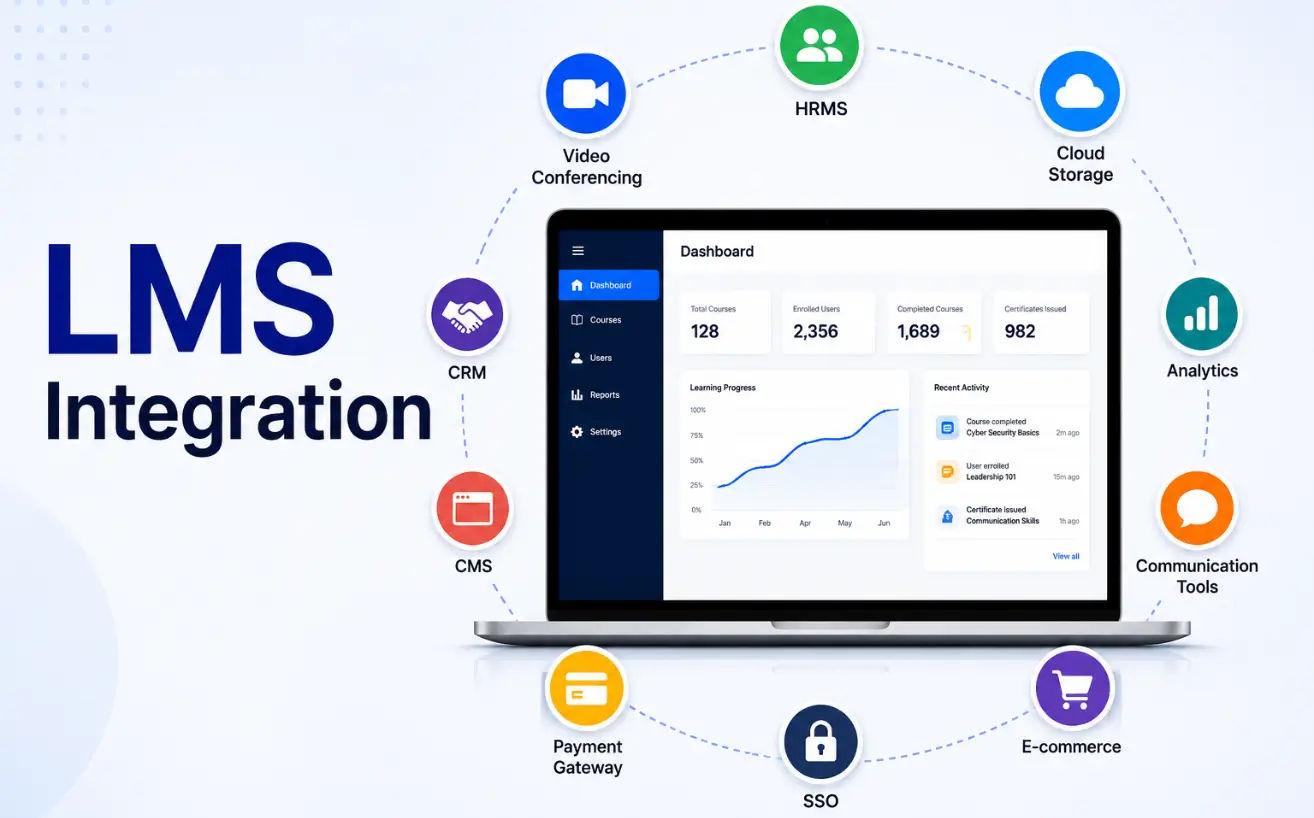
Modern businesses no longer use a Learning Management System as a standalone platform. Employee training, customer onboarding, compliance management, sales enablement, and performance tracking now depend on multiple business tools working together. This is where LMS integration becomes important. Organizations today use HR software, CRM platforms, communication tools, analytics systems, and cloud applications daily. If these systems operate separately, teams spend more time managing data manually than improving learning experiences. LMS integration helps businesses create a connected digital learning environment where information flows automatically between systems. It improves operational efficiency, reduces repetitive work, and makes training more accessible and measurable. As remote work, hybrid learning, and SaaS adoption continue to grow, LMS integrations have become a critical part of scalable learning infrastructure.
What is LMS Integration?
Modern businesses no longer use a Learning Management System as a standalone platform. Employee training, customer onboarding, compliance management, sales enablement, and performance tracking now depend on multiple business tools working together. This is where LMS integration becomes important.
Organizations today use HR software, CRM platforms, communication tools, analytics systems, and cloud applications daily. If these systems operate separately, teams spend more time managing data manually than improving learning experiences.
LMS integration helps businesses create a connected digital learning environment where information flows automatically between systems. It improves operational efficiency, reduces repetitive work, and makes training more accessible and measurable.
As remote work, hybrid learning, and SaaS adoption continue to grow, LMS integrations have become a critical part of scalable learning infrastructure.
LMS integration refers to the process of connecting a Learning Management System with other software applications, platforms, or business tools to streamline workflows and improve functionality.
Instead of requiring users to switch between disconnected systems, integrations allow the LMS to exchange data automatically with external platforms.
For example: When an HR system is integrated with an LMS, new employees can automatically receive onboarding courses as soon as they join the organization. Similarly, CRM integration can help sales teams access training related to products, customer communication, or compliance directly within their workflow.
LMS integrations help businesses centralize training operations while improving automation, reporting accuracy, and user experience.
Why LMS Integrations Matter for Modern Businesses
Businesses today rely on multiple technologies to manage operations. Without integration, training systems often become isolated, leading to data silos, manual processes, and poor learner engagement.
LMS integrations solve these problems by creating a unified ecosystem where learning connects with business operations.
Companies benefit from LMS integrations because they:
- Reduce administrative workload
- Automate user management and enrollments
- Improve employee onboarding
- Enhance learner engagement
- Simplify compliance tracking
- Provide centralized reporting and analytics
- Support remote and hybrid learning environments
As organizations scale, integration becomes essential for maintaining efficiency and delivering consistent learning experiences. Businesses investing in a custom LMS development service should prioritize scalable integrations that support future business growth.
Benefits of LMS Integrations
- Improved Automation: Integrations reduce repetitive manual tasks such as course enrollment, attendance tracking, certification management, and user updates.
- Better User Experience: Employees and learners can access training platforms more easily through connected systems and single sign-on functionality.
- Accurate Reporting: Integrated systems combine data from multiple sources, helping businesses measure learning performance and return on investment more effectively.
- Increased Productivity: Teams spend less time switching between platforms and more time focusing on learning and performance improvement.
- Scalability: Integrated LMS platforms are easier to scale as businesses grow and adopt new technologies.
1. HRMS Integration
Human Resource Management System integration is one of the most important LMS integrations for businesses.
It allows employee information to sync automatically between HR platforms and the LMS. This simplifies onboarding, compliance training, and performance tracking.
Key Benefits
Popular HRMS platforms include Workday, BambooHR, and SAP SuccessFactors.
2. CRM Integration
CRM integration connects the LMS with customer relationship management systems.
This integration is commonly used by sales and customer support teams who require ongoing product knowledge and customer service training.
Key Benefits
Popular CRM platforms include Salesforce and HubSpot.
3. Video Conferencing Integration
Remote and hybrid learning have increased the demand for live virtual training sessions.
Video conferencing integrations allow instructors to host webinars, live classes, and training sessions directly through the LMS.
Key Benefits
Popular tools include Zoom, Microsoft Teams, and Google Meet.
4. Single Sign-On Integration
Single Sign-On integration allows users to access multiple systems using one secure login.
This improves accessibility while reducing password-related issues.
Key Benefits
SSO integration is especially useful for enterprises with multiple digital platforms.
5. Payment Gateway Integration
Payment gateway integration is essential for organizations selling online courses or subscription-based learning programs.
It enables secure payment processing directly within the LMS.
Key Benefits
Popular payment solutions include Stripe and PayPal.
6. CMS Integration
Content Management System integration allows businesses to manage blogs, training resources, landing pages, and educational content more efficiently.
This integration supports content-driven learning strategies.
Key Benefits
Popular CMS platforms include WordPress and Drupal.
7. Analytics and Reporting Integration
Analytics integrations help organizations monitor learner behavior, course performance, and training effectiveness.
Data-driven insights help businesses improve learning strategies and employee development programs.
Key Benefits
Advanced reporting is essential for enterprises managing large-scale learning operations.
8. Communication Tool Integration
Communication integrations improve collaboration and learner engagement.
They allow teams to receive course notifications, updates, reminders, and training discussions through familiar communication channels.
Key Benefits
Popular communication tools include Slack and Microsoft Teams.
9. E-commerce Integration
E-commerce integration allows organizations to monetize their learning platforms by selling courses, memberships, or certifications online.
This is particularly useful for EdTech companies, coaching businesses, and training providers.
Key Benefits
This integration supports scalable digital learning businesses.
10. Cloud Storage Integration
Cloud storage integrations help businesses securely store and manage training resources such as videos, documents, presentations, and certificates.
Key Benefits
Popular cloud storage platforms include Google Drive and Dropbox.
How LMS Integrations Improve Employee Training
Integrated LMS platforms create a smoother and more engaging training experience for employees.
New employees can automatically receive onboarding courses, managers can track progress in real time, and teams can access learning materials without switching between multiple platforms.
Integrations also improve personalized learning by allowing businesses to recommend courses based on job roles, skills, or performance data.
For remote and hybrid teams, integrated communication and video conferencing tools make learning more interactive and accessible.
Overall, LMS integrations help organizations deliver faster, smarter, and more effective employee training programs.
Common Challenges in LMS Integration
Although integrations provide significant benefits, businesses may face several implementation challenges.
- Compatibility Issues: Some legacy systems may not integrate easily with modern LMS platforms.
- Data Security Concerns: Businesses must ensure secure data transfer between systems to protect employee and customer information.
- Integration Complexity: Large organizations often require custom integrations that involve technical planning and development.
- User Adoption Problems: Employees may need training to adapt to newly integrated systems and workflows.
Working with experienced LMS developers can help businesses avoid these challenges and ensure smoother implementation.
Tips for Choosing the Right LMS Integrations
Choosing the right integrations depends on business goals, learning requirements, and existing technology infrastructure.
Here are a few important considerations:
- Identify operational challenges before selecting integrations
- Prioritize integrations that improve automation and efficiency
- Choose scalable solutions that support future growth
- Ensure strong security and compliance standards
- Select platforms with reliable API support
- Focus on user experience and ease of access
Businesses should also evaluate whether they need off-the-shelf integrations or custom integration development.
Conclusion
LMS integration plays a critical role in building modern, scalable, and efficient learning environments.
By connecting learning platforms with HR systems, CRM software, communication tools, analytics platforms, and cloud applications, businesses can automate processes, improve learner engagement, and centralize training operations.
As organizations continue adopting digital learning strategies, the demand for flexible and scalable LMS integrations will continue to grow.
Businesses investing in custom LMS development should prioritize integrations that support operational efficiency, user experience, and long-term scalability.
Frequently Asked Questions
What is LMS integration?

Why are LMS integrations important?
Which LMS integration is most important?
Can custom LMS platforms support third-party integrations?
What are the benefits of CRM integration with an LMS?
Looking to Build a Scalable LMS Platform?
Looking to build a scalable LMS platform with seamless third-party integrations? Talk to our LMS development experts.
Talk to Our LMS ExpertsUday Tanwar
Uday Tanwar is the CEO of BYXL Software, where he leads a team focused on building custom software, mobile apps, web platforms, and business automation solutions. With years of experience in technology strategy and digital product development, he helps businesses turn ideas into practical, scalable systems that support long-term growth. His expertise includes software consulting, process optimization, and delivering user-focused solutions for startups, small businesses, and growing enterprises. Through his leadership, BYXL Software continues to deliver reliable technology solutions tailored to modern business needs.