
Introduction: Why Most Businesses Struggle to Get Consistent Leads
Many businesses invest in digital marketing but still fail to achieve consistent enquiry flow. Traffic may increase temporarily, campaigns may run, and content may be published, yet the outcome remains unstable. The core issue is not effort, but the absence of a structured system that guides users from awareness to conversion.
Without a defined framework, marketing becomes fragmented. Results fluctuate, and scaling becomes difficult. Full funnel marketing addresses this gap by creating a structured, predictable journey for potential customers.
Businesses that want predictable growth often move toward integrated solutions such as the Growth Factor Bundle, where SEO, paid campaigns, content marketing, and lead generation strategies work together within a structured funnel system.
Understanding Full-Funnel Marketing: The Complete Growth System
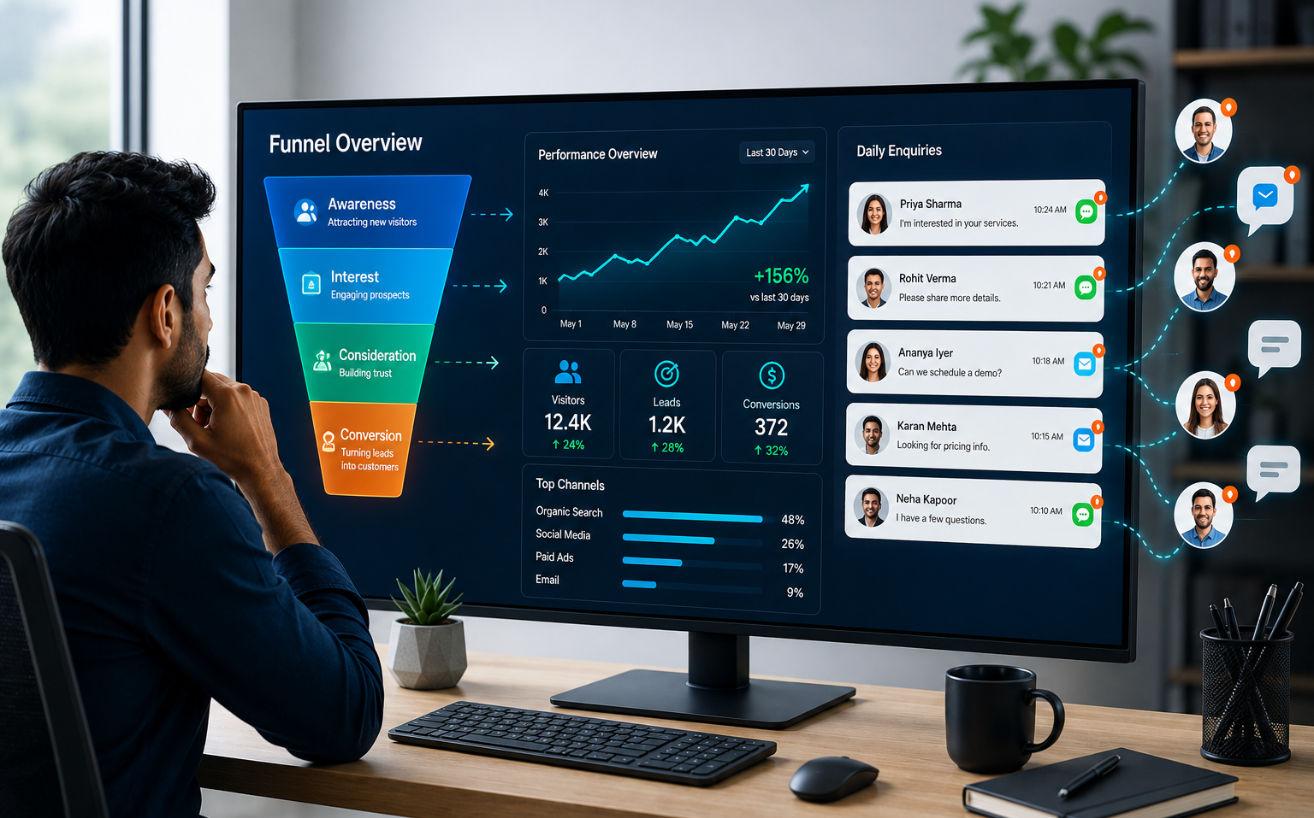
Full funnel marketing is a strategic approach that maps the entire customer journey, from first interaction to final conversion. Instead of focusing on isolated marketing activities, it integrates them into a cohesive system.
The framework is built on three core stages:
1. Top of Funnel (TOFU): Awareness
2. Middle of Funnel (MOFU): Consideration
3. Bottom of Funnel (BOFU): Conversion
Each stage serves a specific purpose. When aligned properly, they create a continuous flow of qualified leads and improve overall marketing efficiency.
Stage 1: TOFU (Top of Funnel) – Building Awareness That Attracts Attention
At the TOFU stage, the objective is visibility. The audience is not yet familiar with the brand and is primarily searching for information or solutions to their problems.
Key activities include:
- Search engine optimized content
- Educational blogs and guides
- Social media visibility campaigns
- Awareness focused advertising
A common mistake at this stage is direct selling. Instead, the focus should be on addressing user intent and building initial awareness.
For example: A user searching for a problem-related query is in the discovery phase. Providing valuable insights at this stage positions the brand as a trusted source for future engagement.
Stage 2: MOFU (Middle of Funnel) – Turning Interest into Trust
In the consideration stage, the audience is aware of the brand and is evaluating available options. The primary objective here is trust building and relationship development.
Effective strategies include:
- Detailed case studies and success stories
- Comparative content and solution guides
- Email nurturing sequences
- Retargeting campaigns
- In-depth service or product explanations
This stage plays a role in decision-making. If trust is not established here, potential leads are often lost to competitors. Businesses that neglect MOFU typically experience high traffic but low conversion rates.
Stage 3: BOFU (Bottom of Funnel) – Converting Leads into Customers
At the bottom of the funnel, the user is ready to make a decision. The focus shifts entirely to conversion optimization.
Key elements include:
- High-performing landing pages
- Clear value propositions
- Client testimonials and proof of results
- Transparent pricing or consultation offers
- Strong and direct call-to-action elements
At this stage, even minor friction can impact conversion rates. A well-structured BOFU experience ensures that interested users convert into enquiries or customers efficiently.
Why Single-Channel Marketing Fails to Deliver Results
Many businesses rely heavily on a single marketing channel such as paid ads or SEO. While these channels can generate traffic, they rarely deliver consistent results in isolation.
Common limitations include:
- Lack of nurturing for new visitors
- No structured follow-up mechanism
- Poor alignment between traffic and conversion strategy
A single-channel approach fails because it does not address the entire customer journey. Full funnel marketing eliminates this gap by integrating multiple touchpoints into one system.
How SEO, Ads, and Content Work Together in a Funnel Strategy
A successful funnel depends on the integration of multiple channels working in coordination.
1. SEO drives long-term organic visibility at the awareness stage
2. Paid advertising accelerates reach and targets high-intent users
3. Content builds authority and educates potential customers
When combined strategically, these channels create a continuous movement of users through the funnel, improving both lead quality and conversion rates.
Modern funnel strategies are also becoming more data driven through automation and intelligent targeting. Businesses adopting advanced technologies are increasingly exploring how AI improves personalization, audience targeting, and campaign optimization across the funnel. This shift is explained in detail in this guide on AI in Digital Marketing.
The Role of Landing Pages and Lead Capture Systems
A website alone is not sufficient for conversion-focused marketing. Dedicated landing pages play a critical role in guiding users toward action.
An effective landing page includes:
- Clear and focused messaging
- Problem-solution alignment
- Social proof such as reviews or case studies
- Minimal distractions
- Strong conversion-focused calls to action
Additionally, structured lead capture systems ensure that every visitor has a defined pathway to engage with the business.
Retargeting and Follow-Ups: Turning Cold Leads into Hot Enquiries
Most users do not convert during their first interaction. Retargeting and follow-up systems are essential for bringing them back into the funnel.
Key mechanisms include:
- Retargeting advertisements across platforms
- Email nurturing campaigns
- Reminder-based communication strategies
These touchpoints reinforce brand recall and gradually move users from interest to action. Businesses that implement consistent follow-ups significantly improve conversion efficiency.
Common Mistakes Businesses Make in Funnel Marketing
Despite its effectiveness, many businesses fail to implement funnel marketing correctly due to common mistakes such as:
- Overemphasis on traffic without conversion strategy
- Ignoring middle funnel nurturing processes
- Using generic messaging across all stages
- Lack of tracking and performance analysis
- Dependence on a single acquisition channel
These gaps result in inconsistent performance and inefficient marketing spend.
Real Impact: How Businesses Go from Zero Leads to Daily Enquiries
When implemented correctly, full funnel marketing transforms unpredictable marketing into a structured growth system.
Businesses typically experience:
- Consistent daily inbound enquiries
- Improved lead quality
- Higher conversion rates
- Reduced cost per acquisition over time
The most significant outcome is predictability. Marketing becomes a controlled system rather than an uncertain activity, enabling scalable growth.
Final Thoughts: Building a Predictable Lead Generation System
Full funnel marketing is not just a tactical approach, but a complete business growth framework. It ensures that every stage of the customer journey is strategically addressed.
Businesses that rely on isolated marketing efforts often struggle with inconsistency. In contrast, those that adopt a structured funnel system achieve sustainable lead generation and long-term scalability.
A well-designed funnel transforms marketing from reactive execution into a predictable growth engine.
Uday Tanwar
Uday Tanwar is the CEO of BYXL Software, where he leads a team focused on building custom software, mobile apps, web platforms, and business automation solutions. With years of experience in technology strategy and digital product development, he helps businesses turn ideas into practical, scalable systems that support long-term growth. His expertise includes software consulting, process optimization, and delivering user-focused solutions for startups, small businesses, and growing enterprises. Through his leadership, BYXL Software continues to deliver reliable technology solutions tailored to modern business needs.